The Lazy Lever: A Simple Path to Superior Returns
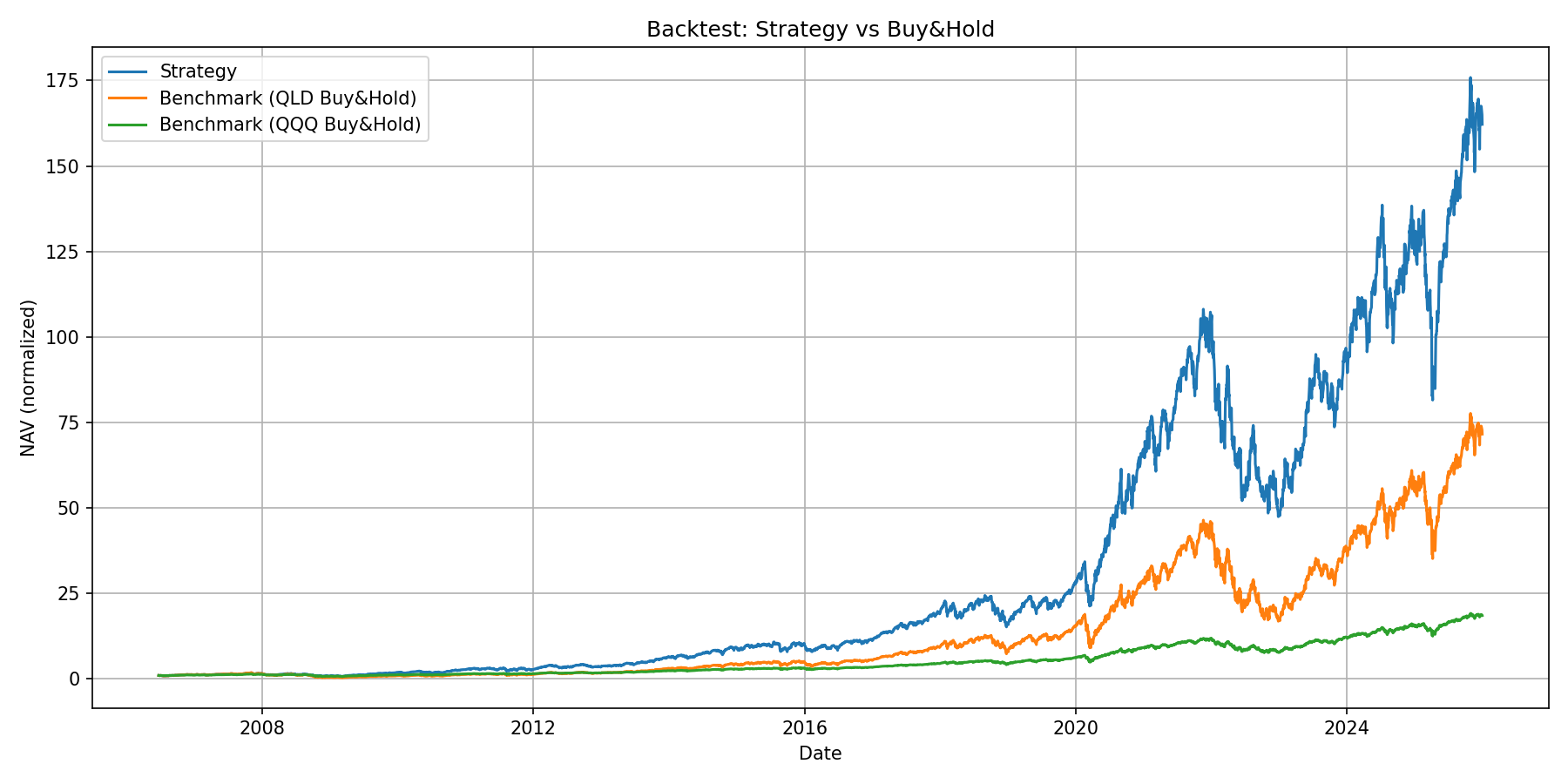
Why spend hours analyzing balance sheets when you can outperform the market with less than four trades a year? The Lazy Lever strategy is designed for the modern investor who wants high returns without the high maintenance.
Core Philosophy
- Unpredictability: We cannot consistently predict short-term market movements. Therefore, we remain fully invested to capture all major uptrends.
- Strength: We invest in the strongest long-term index—the Nasdaq 100—to simplify our portfolio and eliminate the need for individual stock research.
- Leverage: We utilize leveraged ETFs to amplify returns during favorable market conditions.
Why the Nasdaq 100?
The Nasdaq 100 is the engine of the modern economy. It represents the top non-financial innovators globally. Historically, it has outperformed the S&P 500 by a significant margin because it concentrates on growth sectors like technology, biotechnology, and consumer services.
The "Goldilocks" Zone: Why 2x (QLD) and not 3x (TQQQ)?
Greed often leads investors to 3x leveraged ETFs like TQQQ. However, leverage cuts both ways. The phenomenon of volatility decay is magnified at higher leverage.
"According to simulations by HavocFuture, if you had held a 3x leveraged fund (like TQQQ) through the 2000 Dot-Com Bubble, your maximum drawdown would have reached -99.91%. It would take over 20 years just to break even."
The Lazy Lever uses QLD (2x Leverage) as the primary offensive engine. It provides a sweet spot: doubling the daily returns of the Nasdaq 100 while maintaining a recovery profile that is mathematically feasible after a bear market, unlike the potentially unrecoverable wipeouts of 3x funds.
The Strategy Mechanism
This is not a "Buy and Hold" strategy, nor is it high-frequency trading. It is a tactical switching strategy.
- Bull Market (Risk On): Hold QLD (ProShares Ultra QQQ). This captures 2x the upside.
- Bear Market (Risk Off): Switch to QQQ or QQQM (1x Leverage). This reduces exposure to volatility decay and prevents catastrophic drawdowns.
Note on Methodology: We do not rely on a simple 200-day Moving Average, which can often lag and result in "whipsaws." Instead, we utilize a proprietary signal updated daily that accounts for price momentum and volatility. While the exact formula is private, the signal is transparently published here every day.
Surviving the Crash
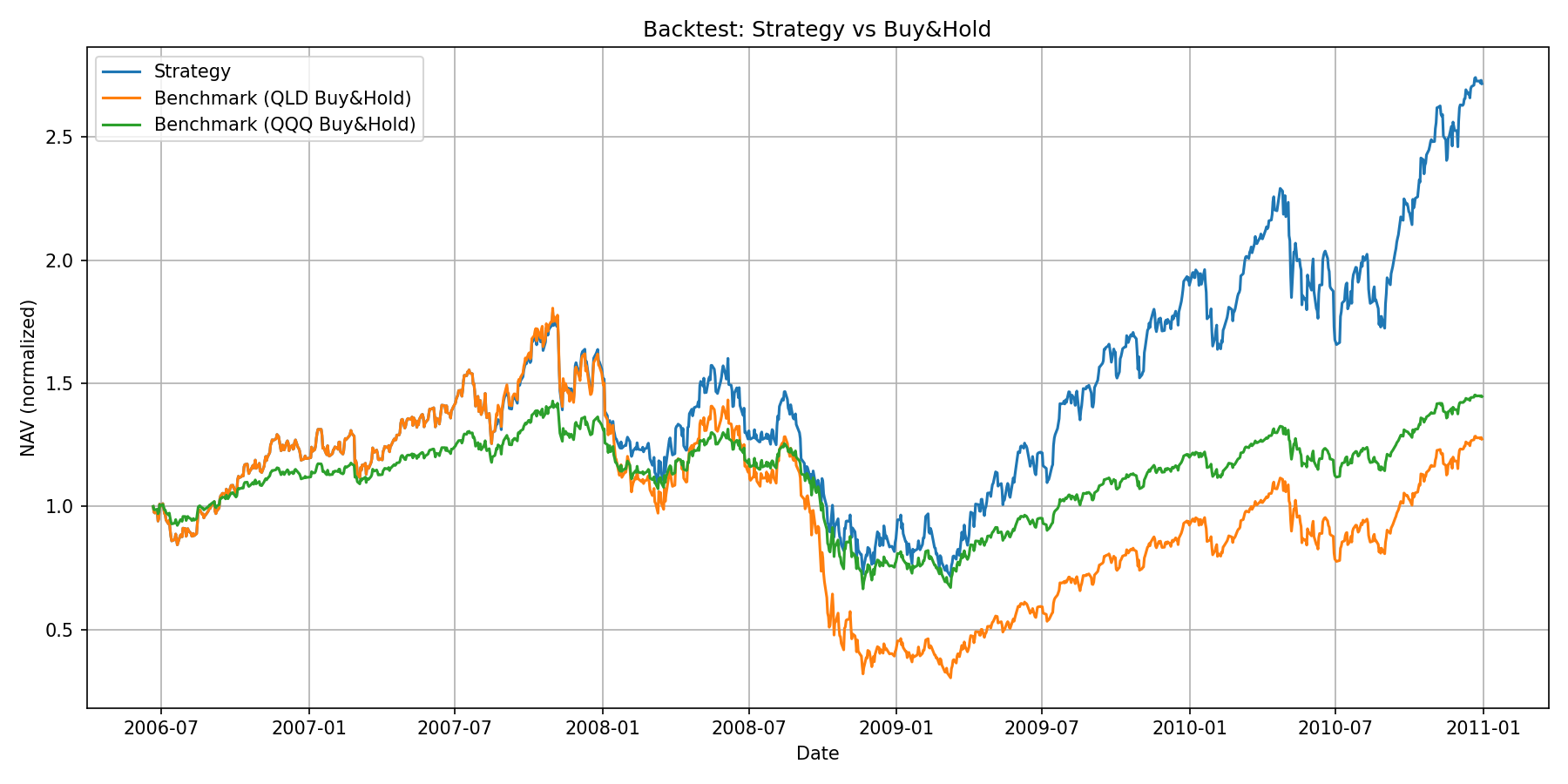
The power of this strategy was proven in our backtests covering the 2008 Financial Crisis. While the buy-and-hold QLD investor suffered a devastating -83.13% loss, The Lazy Lever signal switched to the defensive QQQ asset, limiting the maximum drawdown to roughly -60% and preserving the capital needed to ride the subsequent recovery.